Friday, 11 August 2023

Royston: Of crossroads and cave, crooks and crows


Royston, Stone, Roisias cross, Pyschogeography

Smoke and Mirrors (aka Crab and Bee aka) describe the town of Royston in 'The Pattern' thus:


'Royston is a place from which the power has been removed.A hollow left behind when the roof was pulled. There are many signs of the hooded crow but no hooded crows'.

Re-reading that section of The Pattern prompted a long belated trip to the town of Royston and a visit to the Royston Cave.

The Cave and Royston generally have been lurking in the back of my mind for some time. I've never properly been to Royston, only briefly passed through it or visited the Royston Heath as a child, memories of which are vague and involve Peter Powell kites, balsa wood gliders and my grandad.  The town is only about 15 minutes away from Cambridge by train. I wasn't really sure why I'd never been.

The first notable point after leaving the station and heading in the direction of the town centre along The Old North Road was the small museum. The exhibits that seemed most significant  were a taxidermy hooded crow and the model of the Priory Cinema. In fact, I can't swear it was a model, it may have just been a photograph. The memory of most of the exhibits in the museum faded soon after leaving, so it's likely I've misremembered.

The cinema opened in the early 1930s and featured typical brown brick of the time but with unusual octagonal features in the design. It was demolished in 2002 to make way for housing, but seems to remain as nearly as important  in the memory of the town as the hooded crow.

The hooded crow was once a common visitor to Hertfordshire and in particular Royston, to the extent that it is often referred to a the 'Royston Crow'. The name was also given to local cavalier supporters who brawled with visiting Roundheads in the Cromwellian era. It has for years also been the name given to the local paper.
 
Old North Road/Kneesworth Street or Ermine Street, met the crossroads with the Icknield Way soon after. Both the Cave and the Royce Stone sit at the conjunction of the two ancient routes. I spotted The Cave Shop, which sits adjacent to the Cave entrance.  But since our visit to the cave was not due for a couple of hours, we continued over the crossroads. I had intended to stop and investigate the Royce Stone,  but the presence of an ogre-like man standing next to it like a guard dissuaded me. He had an energy drink in one hand and a fag in the other, and was and using the depression on the stone as an ashtray. The stone is said to be the original base of Roisia's Cross, named after the Lady Roisia who may have erected the cross or repaired an already existing one, at a time when the town had yet to be established in the 10th century. The town, which subsequently grew up around the crossroads, is said to be named after her. Roisia's Town was later truncated to Royston, the stone became the Royce Stone. 

During a brief and incoherent wander through the town, in which we took in in the Priory Gardens and some side alleys off the main shopping street, we encountered more a modern but no less curious and completely unexplained stonework. Then we headed to Therfield Heath.

Royston, Hertfordshire, Public Art, Psychogeography


Therfield Heath is the place I knew as Royston Heath as a child. Now it is a nature reserve , a Special Site of Scientific Interest on part of  a large chalk escarpment. No kite flying was evident.  To the West, the nature reserve gave way to a golf course featuring prehistoric long barrows. Further in the distance I could clearly see the Sandy Heath Transmitter, looming up from the neighbouring county of Bedfordshire. The Icknield Way was signposted, cutting across the Health and  heading south to Baldock and Letchworth, north-west, out of the town and passing through the Greenwich Meridian before  bypassing Cambridge, on to Newmarket and beyond.  As I sat taking in the view, among a profusion of wild flowers and bees,  something flew over me. A hooded crow. Or was it? Crab and Bee say there are none and the Kent Ornithological Society say that the last sighting in Royston was in 1985. The image is still clear in my mind, but may well have been a projection of my geographic imagination brought about by the earlier visit to the museum and the still present spectre of the crow throughout the town. 

Royston Heath, Psychogeography, Herfordshire

Our appointment at the Cave meant we didn't have too long to linger. On the way back through the town, we diverted through Angel Pavement, a 60s pedestrian shopping precinct which both stood out and blended in with the older buildings in the town centre to form an  atmosphere typical of London commuter belt Hertfordshire towns, including neighbours like Letchworth or Hoddesdon.  Royston seemed unusually quiet. It was Saturday, early afternoon but felt more akin to a Wednesday morning such was the lack of people. Coming from Cambridge,where town on Saturday is best avoided due to the overwhelming volume of tourists and shoppers, this was a minor revelation.
 
Angel Pavement featured a newly opened independent bookshop, the only one in Royston and something that is a rarity generally.  We diverted in to have a look. They had what looked like an interesting topography section. But before I'd had a good look,  I was distracted by a display of books in the centre of the shop being 'manned' by a posh sounding lady. The books were all by Jeffrey Archer and I realised that he had been invited to come and sign books to mark the opening of the shop. I remembered Archer coming to talk at an assembly at my school many years ago where he had made much of the virtues of honesty and hard work. I remember not being very convinced at the time. Subsequent events and revelations about Archer, which ended in his imprisonment for perjury, seemed to bear out my scepticism. We left the shop before he had a chance to arrive.

Archer was not from Royston, but is most usually associated with Grantchester, just on the edge of Cambridge, where he  still lives with Mary Archer in the Old Vicarage. The TV programme Grantchester, set in a fictionalised version of the village sometime in the 1950s, has no connection to Archer, although central to the programme is criminal activity and a vicarage. The crimes in the TV series were usually murders, not perjury, lying or cheating. The day we arrived in Royston,  Archer had chosen to come from Grantchester, the fictional vintage murder hotspot, to Royston, to open a bookshop.  
 
Royston does have a more recent and much less sanitised, if less frequent, history of murder than the fictional 'Grantchester'. The non-fictional murder of Helen Bailey, a children's book author from Royston happened in 2016. Had she still been alive, she would have probably been a far more suitable candidate to open a bookshop in Royston. She was murdered by her fiance Ian Stewart,  who hid her body and that of her dog in a septic tank at her house. It emerged the Stuart had in the past played bowls at the same club as my Dad. My Dad said he always thought there was something 'a bit odd' about him.  Stewart was later also convicted of killing his previous wife back in 2010.

I was with these black thoughts and the image of the grinning face of Jeffrey Archer stubbornly refusing to shift from my minds eye, that we headed to the Cave. After a short wait loitering in the passage next door with others who had booked the tour, we were welcomed in by the guide. After a short decent we were in the chamber, which had been cut out of chalk and was festooned with carvings of unknown age and origin, as well as 17th century graffiti. The Cave was discovered in the 17th century when some works above accidently revealed the opening, but thought to date from at least the 1300's.

Royston, Cave, Herforeshire, Psychogeography
 
Several figures were depicted in the carvings. One was said to be by some St. Christopher, patron Saint of Travel, probably the nearest thing the Christians can offer to a psychogeographic figure. Others think the carving represents Hermes, The Greek God of travel and messenger to the Gods. In modern times, that name is more associated with disgruntled gig economy workers who throw parcels over fences to express their distain at 21st Century labour market conditions.
 
Explanations and theories about who the figures in the carvings were supposed to be or what they represented are many and varied. The same is true of the cave itself. The guide explained that nothing had ever been proven, so people were free to believe in whichever theory they liked. There are various theories suggesting the cave may have been a prison, hermitage, hiding place for religious dissenters, site of pagan worship or possibly most popular, that it was connected to the Knights Templar. The guide clearly had met people with all sorts of theories and beliefs that visited, some more out-there than others. Midsummer day was only a few days before we visited, when the number of Earth Mystery types and dowsers visiting the caves increases.  The Cave is thought to be at an intersection of the The Mary and Michael Ley Lines, which in turn are said to lead in different directions to nearby sites associated with the Templars, who some say were skilled at the art of dowsing. 

Another feature of the cave was that it had apparently had a wooden platform on all sides, octagonal in shape. I was reminded of the octagonal features of the Priory Cinema and wondered if there was some sort of connection.

I can't say I felt anything unusual in the Cave, although it was without doubt an unusual and unique place. I did enjoy  the much welcome cool air found underground, and the chamber provided a refuge from the heat we had escaped from outside. In a previous era it may have offered refuge from other uncomfortable or dangerous situations. But can't say I felt any weird energy or had any moments of revelation. 

But when we emerged a man was standing in the alley outside. He had came out of the Cave before the tour had finished and looked a bit shaken. We enquired if he had felt claustrophobic. The chamber was fairly small, particularly when filled to capacity by hit people on the tour. He said no. He had though apparently felt some kind of bad energy present in The Cave, and had had to get out.

Royston Cave, Psychogepgraphy, Hertfordshire
 
We had a brief look in the Royston Cave Shop next door. It was full of the sort of paraphernalia to be found in New Age type shops of the sort that I imagine  proliferate in Glastonbury. I had a look at the books, some of which were concerned with the Cave and the Knights Templar. Others were not Royston centric, but included quite a bit of  Erich Von Daniken inspired ancient aliens type volumes as well as the typical new age sort of stuff. After leaving the Cave Shop we crossed the road and passed above the original entrance to the cave, marked by a sort of manhole cover immediately outside of Bet Fred, where two punters had come out for a fag break.The contrast between the scenes above and below ground were stark. Back on the surface, the intrigue of the Cave was quickly replaced by the dull and ordinary scene of a betting shop exterior. The boundary between old and new Royston was  a thin one, between the road surface and the chamber of the Cave 

One thing I didn't see in the Cave Shop shop or hear anything about on the tour was the assertion that Royston sits at the heart of the 13th sign of the British Zodiac. I stumbled across a short paper explaining this on the internet after I got home. First I was stuck by the impressive green and purple cartographic image, which had at its centre High Cross, where Watling Street and Fosse Way intersect near Leicester.  Royston is depicted directly South East, apparently at the heart of Ophiuchus, the constellation marking the 13th Sign. The sign apparently 'signifies a new cycle of time and initiation at a higher evolutionary level than before'. The paper manages to bring together the Round Table, King Arthur and the Grail, The Knights Templar, the aforementioned Michael and Mary Ley Lines and Roisia's Cross, with the Royston Cave at the centre of all this. It goes on to suggest that Royston was the  place of origin for the Hot Cross bun custom and ties this back to St. George, The Red Cross (Roisias Cross) and the Cave as a place of  rebirth. 
 
I first assumed the paper had been deposited online as a prank and assumed it was something that had been written in the spirit of the London Psychogeographical Association, Luther Blissett or the Church of The Subgenius. But a further look at the Francis Bacon Research Institute website made me doubt my initial assumptions and it seemed to be an entirely serious organisation. I was though still sceptical about the hot cross buns and it turned out rightly so as they were invented by  Brother Thomas Rocliffe in St Albans Abbey, at least according to other bits of the internet. St Albans is still in Hertfordshire and not that far away from Royston, so I guess they were not too far off the mark. Although St Alban's appears peripheral to the 13th sign of the zodiac at best.
 
Before we departed the crossroads, I noticed that there was now no ogre guarding the Royce Stone, so I went for closer look. It was set on a fairly recent looking stone platform,  with an engraving encircling it that gave a brief explanation of the object. That it was situated in an otherwise unremarkable setting, a street science typical of any nearby Hertfordshire commuter town, enhanced the significance of the object. The stone, which if the stories of Roisia's Cross are true, predates the town and was a catalyst for its development around the crossroads at the intersection of ancient tracks, (possibly) the Ley Lines and to the West the Greenwich Meridian.

Adding a further layer of intrigue was the appearance of 'Nigel' on a bin next to the stone. The tag is (as far as I know) native to Cambridge. Nigel's appearance in Royston mirrored Archers and our own. A day away in the peripheral zone of Royston, an escape to a sort of non-place away where one could dissapear temporarily. It was clearer now why Smoke and Mirrors described the town as having had the power removed. The townscape surrounding the cave felt like a place that was less alive than it might once have been. A place where much passes through but little stays. I had read that the original Meridian Marker in the west of the town had been stolen in 2007 and had to be replaced. The nearby Meridian school closed down following conversion into an academy and subsequent merger with two other schools. The town appeared to be in a state of downsizing to the point of being somewhere mostly used just to pass through, as it was before it properly existed. I surmised that the departure of the Royston Crow in 1985 had probably heralded a  reversion whereby the town became peripheral in every sense to the crossroads at its centre. The cross roads once again becoming became the only focal point, a place of passing through, channelling travellers in and out without encouraging them to stop. Ironically, the resulting subdued atmosphere of the town was something I had enjoyed, it had made a nice change. We had come with the purpose of not just passing through, which felt like a disruption of what the town really wanted us to do. Although we did not feel unwelcome, but not really welcome. Just left alone.  A day in the town was like the equivalent of a lengthy sit on a park bench in the middle of a long walk. A welcome and peaceful respite from the horrors of the modern world in a place neither salubrious or horrific, but one semi-sonambulant. Somewhere in between things.

Nigel, Rotston, Psychogeography


Footnote:

The Royston Cave website contains much information about the Cave and the various theories connected to it.

https://www.roystoncave.co.uk/


Saturday, 17 June 2023

Terminalia: The North-East Cambridge Boundary Conjunction

Psychogeography, Cambridge, 13th Public Drain
 

I set out to mark Terminalia, Festival of Terminus, Roman god of borders and boundaries. I had missed the actual day of 23rd Feb due to not being able to get time off work. So was not able to participate in any of the events of the Terminalia Festival of Psychogeography, nor carry out any sort of significant perambulation on the actual date.

Last year I did a walk along and about the A14, in the zone between the Histon and Milton fly-overs and the northern extremity of Cambridge city boundary. I never got around to writing the blog, but did do a live twitter feed.  I was glad to  have been followed by a handful of real people as well as an A14 bot account. The latter appeared to function as a traffic update service. Any hashtagged mention of A14 in a tweet prompted an almost instant retweet. If the walk had served no other purpose, disrupting traffic updates with notes and pictures of my observations of the peripheral environment that surrounded the dual carriageway felt oddly satisfying.

One of those observations was a confluence of borders and boundaries. It was located at the very limits of the North Eastern part of County Parish Boundary at the point where it  encompasses the meeting point of the 13th Public Drain, the 1st Public Drain (or at least an offshoot thereof) and the railway line. Here, the county boundary follows the course of the 13th Public Drain West to East for a short section until it intersects with the 1st and aligns with its route back South across the A14. The hum of the A14 could be heard or maybe the right word is felt from the spot as I stood at the confluence. On that day, the direction of the wind was such that another hum, emanating from the Cambridge Water Treatment Works the other side of the A14, permeated the air  This added another important, if slightly unpleasant, dimension to the feel of the small zone around the conjunction.

This year I set off for a walk on Saturday 25th February, a couple of days late. I had no real thought as to where I might go and had allowed myself to drift. On passing the former Hopbine Pub, the building currently squatted by the Cambridge Community Food Hub, I saw the first 'Nigel' of the day. The tag, while not obviously anything connected to borders and boundaries, marked a point between aimlessness and a more decisive 'plan'. I decided to head back to the confluence of the 13th and 1st public drains.

Nigel, Tag, Cambridge, Street Art, Psychogeography

Having crossed  Midsummer Common and the River Cam, I walked the length of Milton Road, a key arterial road joining the city to the A14. The initial stage was uneventful.  It was impossible to carry on past the shops that make up the parade opposite the Portland Arms. Roadworks blocked my path.  This stretch is seemingly as yet untroubled by neither the creeping gentrification nor clone town uniformity that has taken hold in other parts of the City.

It wasn't long until I reached the second row of shops beyond the next roundabout. Here I was immediately confronted with a notice protesting about the proposed congestion charge. This scheme, devised by the Greater Cambridge Partnership, is  currently at the post consultation analysis stage, the results may well be out by the time you read this. Unsurprisingly the idea has divided opinion  among the population of 'Greater Cambridge', the area that combines both Cambridge City Council and South Cambs District Council territories. It feels like a repeat of the arguments and division caused by the proposed closure of Mill Road Bridge.  The similarity between these two debates makes sense given that the congestion charge is part of a wider strategy that includes  low traffic neighbourhoods, new cycle infrastructure, encouragement of active travel  and less car use. Better public transport is also promised in the form of more buses.

The sign opposing the charge was placed outside Chesterton Carpets, a long  established independent business of the sort rapidly disappearing.  Following the Mill Road Bridge debacle, which was part of a move  towards an ever more sanitised 'vision' of Mill Road catering to the  luxury and artisan end of the market, I couldn't help wonder how long it would be before areas like Milton Road went the same way. Chesterton Carpets or the Viking Chip Shop no doubt are not right sort of independent shops to satisfy the requirements of the 'visionaries'.

The sign took on the meaning of a temporal boundary between the past and the future. This small stretch of shops, much of which is housed in a classic brown brick block, felt like it was in danger of disappearing in its current form. I had a disturbing vision of a beige and glass 'spreadsheet architecture' replacement in the near future.

Cambridge, Psychogeography, Cambridge, Independent Shops

The day after the walk, there was a  protest march and rally against the congestion charge. Among those opposing the scheme, some 'arguments' soon crept in from the more outlandish and paranoid end of the spectrum. Among conspiracy theory types, the urban planning concept of the '15 minute city' is being presented as a government plan to prevent people travelling anywhere beyond a 15 minute walk of their homes.  Local social media commentators reported that Piers Corbyn, who is associated with this sort of thing, had attended the rally in Cambridge. It is clear that among those arguing against the charge there are a minority who have crossed metaphorical border. One that sits between a set of coherent and rational objections about the charge and the sort of flat out paranoia brought on by misinformation via you tube videos viewed by people 'doing their own research'.  

The 15 minute city concept is undoubtedly flawed, like all utopian ideas.  It is hard to see how it can possibly be provided to equally benefit the whole population across such a varied area as 'Greater Cambridge' let alone nationally or internationally. If the Greater Cambridge Partnership could pull off enabling everyone in the area to be able to work, shop, go to the pub, dentist and doctor by with no significant travel involved then that would be great. But its hard to imagine that in reality the current plans will do anything but exacerbate marginalisation, with those living outside the zone having to endure just as painful commute as ever they have. The void between the privileged city residents and those marginalised on the periphery is certain to grow. Included in the the peripheral population are those physically living in the more remote zones of Greater Cambridge (and beyond) who will still have little choice but to drive to Cambridge, having been priced out of the City. Also included are those living in the city on low incomes, the elderly, disabled and other marginalised groups. Of the increasingly few long term residents at the more working class end of the social spectrum, many feel like they are being pushed out or feel they no longer belong.  Those that remain are increasingly invisible as the spaces they occupy are replaced by more clone businesses, high end shops and eateries, life sciences campuses and utterly unaffordable housing.

Works were ongoing on Milton road itself, connected to the new 'vision' of the city. New cycle infrastructure was in the stages of being installed. Traffic cones and other paraphernalia were abundant along the approach to the next major intersection at the Golden Hind pub. Before I reached the Golden Hind, I passed the green topped tower of St.Georges Church in Chesterton, looming behind the houses. This reminded me that Milton Road sliced between Chesterton to the South East East and Arbury to the North West, forming a border itself. It had featured in a walk I did a couple of years ago which was another belated Terminalia excursion concerning boundaries, borders and barriers in and around Chesterton.

The Golden Hind pub marked another threshold, beyond which was a zone much more industrial. The pub, a 1930s tolly folly, is the sort of building that could not be imagined today if somebody decided to construct a new pub (an unlikely event in itself). The building belongs to a past age of ribbon  development, roadhouses and no drink driving laws. The green top of the clock tower is a twin with the tower of St. Georges. The buildings both date from the 1930s and both stand as beacons projected from that time. Both being of significant stature, they seem to represent two opposite but interrelated sides of the same coin. Church or pub may be a polar opposite choice about where to seek refuge and commune. But at least in their physical forms, these two buildings seemed to compliment each other and represent major nodes firmly holding Miton Road's 1930s ribbon development identity in place. It is hard to imagine either building ever not being there. The Golden Hind also has a counterpart in Ipswich, another Tolly Folly of the same name. I passed it during my Ipswich Town Map walk a few years back. The Milton Road Golden Hind emanates an Ipswichian atmosphere, an avatar  providing a portal back to the environs of the Suffolk County Town where most of the rest of the remaining tolly follies reside.

Golden Hind, Cambridge, Milton, Psychogeography, Tollyfolly

Just beyond the Golden Hind, across the street, the pathway submerges and goes under a turn off in the road. This underpass marks the transition into the more industrial zone that features various business parks and industrial sites and most notably, the Cambridge Waste Water Treatment Plant to the East and to the West the Science Park. The Eastern side features probably some of the most edgelandic, marginal space within the City boundary. Much of it is inaccessible. Most of  the rest of it is rarely visited by people who don't work there.

Under the bridge, a green utilities box featured a painted hand with an eye in the centre of the palm. This I assumed might be a Hamsa, a symbol of divine protection against the evil eye. I thought what lay beyond the underpass was probably benign, but maybe this was a symbol of protection or even welcome when crossing the threshold into the next zone. Another meaning of this symbol relates to the Eye of Horus. Something to do with the eye of consciousness being inescapable. The zone beyond was certainly more festooned with more CCTV cameras than I'd seen up until now. But my own consciousness became enhanced around this point of the walk. I had been walking for a while and by now had reached the point where the pace was automatic, steady and metronomic.

I passed the Cambridge Business Park, notable for being inhabited by a building used by BBC local radio after it left Betjeman House off Hills Road.  The move from a more central location, near the Station, botanic gardens and the Flying Pig Pub, was made well in advance of that site being redeveloped (it still hasn't been). Until recently, the new location was also used as a TV studio where the 'Look East (West) regional news programme used to be made. In December last year, the Western outpost was axed and instead of having two versions of Look East , there is now only one that is made in Norwich. The arbitrary boundary between the East and West of the region has been removed as far as BBC Regional TV news is concerned. Anglia TV did the same in 2009. The East-West division that meant Cambridge's Regional News items included reports from places like Corby, Milton Keynes and Northampton. Places that were to my mind more East Midlands than East Anglia. They felt far flung and had me wondering if something was wrong with the television signal. Cambridge had for years suffered a televisual cut off from Ipswich and Norwich. These two places are the county capitals of Suffolk and Norfolk respectively,  the two counties that are the most  East Anglian, some would say are East Anglia. Whether Cambridgeshire is part of East Anglia is subject to debate,which is maybe why it was pushed to the West of the region by those in charge of regional TV in Norwich. It occupies a place on the boundary, in a sort of no mans land as far as its Regional television identity is concerned. It is only due to cut backs that it has been brought back  into the realm of the Anglia Knight.

At this spot, I realised I was not far away from the (former) studios of 'That's Cambridge TV',  located adjacent to the Cambridge Water Treatment Works. The  station used to broadcast local news actually from the confines of the  City, not the Region, at least to begin with. The programme was peripheral in every sense, from the location of the studio it came from to the whole presentation, which was from just beyond the margins of what might be termed 'professional broadcasting'. The anchor man, Jeremy Wilson, was someone who during his short tenure of a year and two months, became a sort of iconic figure. His delivery and interview style was strangely robotic. I wondered if he might in fact be a prototype cyborg made at the science park across the road. The guests who appeared to be interviewed by Jeremy were usually of the most mundane variety: local councillors, school children or people undertaking some sort of good cause or charity activity . Other co-presenters came and went, sometimes reporting on location, let loose from base at Cowley Road to some of Cambridge's more peripheral areas. One woman, whose presenting style could only be described as 'sub-Wilsonian',  was often  banished to the streets to report on violent incidents in Chesterton and Arbury. She seemed unperturbed and was possibly convinced a glittering career in TV journalism awaited. I've seen nothing more of her nor Jeremy Wilson since he left the programme. 

Soon after, That's TV Cambridge became amalgamated with other local 'That's TV'  branches, notably Norwich. Now it has devolved further and we have West Anglia That's TV. This covers places as far flung as Yaxley and Whittlesey and like the BBCs move to pan Regionalism, is undoubtedly the result of cost cutting. This is evidenced by the programming sinking to such low levels that it seems to broadcast endless repeats of the Benny hill Show, a programme I had imagined would probably  not be considered broadcastable in the 2020s. This newer version of That's TV may or may not still come from Cowley Road Studio. This information is as elusive as the current activities or whereabouts of its former presenter.The station may well now be run fully by computers.

Milton road, Cambridge Business Park, BBC, Psychogeography, Jeremy Wilson

The next notable point, not far along from the business park entrance was the appearance of the First Public Drain, emerging from a bifurcated concrete culvert having crossed  Milton Road and Science Park beyond. The graffitied concrete impressively marks this conjunction, although I couldn't figure out why it was split in two. As far as I know (and according to my map) there is only one drain.


Psychogeography, Cambridge, Milton Road

The spot also marked the junction with Cowley Road, which runs parallel with the Drain and is the main route into the zone that contains the Cambridge Water Treatment Plant to the North and the business park and Cambridge North Station to the South. An impressive display adverts for businesses located on the Cowley Road industrial estate festooned the fence opposite from where I was standing. It was refreshing to see advertising with no reference to celebrities or any over the top attempt at 'brand identity'. This was straightforward honest stuff that could only exist at the periphery, where central notions of things like 'brand narrative' and other advertising industry pretentions carry little store.

Cambridge, Psychogeography, Periphery, Milton Road
 
Beyond, the road diverged away from Milton Road. The route ran almost parallel to Milton Road, cuting between  the St. John's Innovation business park to the West and the Water Treatment Works to teh East. The business park was new industry, featuring offices for tech firms and the building that houses (or at least did) the law firm Taylor Vinters. A friend once told me that among legal people the building was known as 'the Belgrano' due to its grey battleship like appearance and possibly because it produced an atmosphere of doom, being one of the more depressing looking buildings Cambridge had to offer at the time. 
 
I was drawn to the older dirtier industrial side. Just before the Sewage works, a large semi-dilapidated warehouse loomed up from behind the blackthorn. Next to it loomed even larger a communications tower and a pylon.


The path ahead towards the A14 was straight and long, stretching alongside The Western extremity of the Water Treatment Works. Much of the side was hidden, fully or partially behind the blackthorn bushes that proliferated in front of the security fence.

 
I passed an entry point. Although the gate was open, it felt very much that I was not permitted to enter. The warning signs indicated the main dangers ahead were humps in the road and pedestrians but the barbed wire that proliferated was no doubt to discourage the curious.


I passed some dwellings that sat the other side of the barbed wire fence, a row of three or four houses that had all the signs of being occupied other than any evidence of actual people. I guess these were where workers or security people lived. Further along, as I walked up the bridge that crosses the A14, to my left was a single dwelling in what looked like its own grounds (I couldn't work out if these were still part of the Sewage Works site of separate).I sumised that this must be the most peripheral location for a house I had encountered within the City boundary, sandwiched between the Sewage Works, the A14 and the Jane Coston Cycle Bridge. Again there was little sign of anyone at home. I wondered who lived in the mysterious dwelling, partially hidden behind scraggy trees and bushes; the last house on the left.


I paused at the mid point of the cycle bridge, at the point where the central reservation cut along the middle of the A14. The A14 marks the physical boundary between the City and the villages and Fenland that lie beyond. But at this point I was still inside the City boundary which runs along the Northern side of the A14  for a stretch that roughly coincides with the boundary of the Sewage works to the South. This is the only place where the City boundary reaches beyond the A14.

Jane Coston Bridge, Cambridge, Psychogeography, Periphery

On my descent into the edges of the village of Milton  on the other side of the bridge, to my right was a some kind of aggregates works, while on the other, the all to familiar spire of a Tesco supermarket, located in an expansive shoppers car park with a petrol station. Both sites were typical of the sort of peripheral zone I was travelling through, although as I observed them they felt anything but mundane. The spire had a quality that I can only describe as sinister, mixed with a numbing futility. The sandy yard, with its tractors and cement mixers on the other hand brought to mind the sort of construction sites we used to play on as kids in the 1980s, in the interim period before a piece of land was turned into an  unspectacular development of Barret houses. The wet weather added a sort of dull Sunday afternoon feel to the atmosphere that was emanating from the site.


I soon found myself entering the Cambridge Road industrial estate, where a sign featured a simple graphic map of the few roads contained within and a list of the various concerns that were located on the site.

 
One of these concerns, Cecil Instruments, featured some impressive signage on its building which had the feel of something of both the future and the past. There was a 1960s Sci-fi atmosphere about it all. Cecil Instruments were founded in 1968 and according to a website called 'Laboratory Talk' are leading designers and manufacturers of HPLC Systems, Ion Chromatographs and UV/Visible Spectrophotometers. I don't know what any of those items are but they sound like things that might be talked of in The Men from Uncle or The Avengers.

 
Attempting to try and follow the city boundary as far as possible, I headed past the building following the road that pointed back towards the A14. Shortly afterwards this road turned left, where it ran parallel to the City Boundary, as near to it as I could get, and the other side the A14. The arrow on the sign for Christmas Trees showed me the way to go.


I passed a concrete GPO post, which appeared to be wearing a toupee of moss. These posts are usually found marking the route of underground telecommunications lines, from the period when the General Post Office ran what become British Telecom. The post, while a curious object in its own right, was a significant border marker. It marked not just the route of a communications route, but also sat at on the City boundary. 

GPO Post, Cambridge, Psychogegraphy,  Edgelands

The city boundary was also marked by the barrier of  hawthorn, bramble and other peripheral flora that ran alongside the road and partially hid a strip of no-mans land that acted as a buffer with the A14 which was elevated above it. The vegetative barrier was festooned with plastic bottles and other litter.  The volume of the detritus increased the further down the road as I walked. The most significant object among it was a dumped armchair, one of several objects too big to have come from car windows on the A14. 


I looked back as I walked and could see the green hoppers from the aggregate site, beyond the air conditioning unit festooned industrial building  I had just past. At the exact same spot on my return, something crossed my path. It resembled in my minds eye a black hound of some kind, but could just have been a muntjac. I had been walking for long enough now for some fanciful ideas to enter my head. That's what I told myself. The road was all but deserted, on a midweek lunchtime, and by the time I walked back from the dead end I found at the bottom it had developed a slightly menacing air.
 
I retraced my steps past Cecil Instruments, and turned into Milton Country Park. Large fishing lakes, previously quarries in a former industrial period, took up most of the park to the North of the 13th Public Drain. But I was more interested in the drain itself and the zone between it and the A14.


I followed the drain towards the confluence. It was crossed by a series of wooden foot bridges, helpfully signposted. This was just as well since the drain was devoid of water at the early stages, and without these markers would have easily been missed. Information online about the drain itself mirrored the lack of water, there was little to be found. I am not certain if it is a man made drain, which is not unlikely given its location in land in what would have been a mixture of farmland and semi-industrial use. But it wasn't entirely straight along it's course, which was quite long for a man made drain. Maybe it was a natural phenomena, just not deemed significant enough to be given a proper name. Apart from this and the 1st public drain I haven't been able to find any others on the map, which begs the question what happened to the others? Was there ever a 12th public drain? The number 13 is of course considered unluck by some and may have special properties. The 13th public drain was a significant boundary marker, not just at the confluence ahead, but also in its route which mimicked the A14, City Boundary and A14, forming another boundary marker at the Northern extremity of the City. The city Boundary could be changed by the whims of Government, but the A14 and the drain are physical barriers, acting as a restraint on the City, keeping it separate from the land beyond. At least for now. Its not unlikely the physical city will extend its reach beyond these in time, as it encroaches its reach. It already has the surrounding area in its hostage like orbit,  as the home counties (and Cambridge itself) are trapped in the gravitational field of London. 


Further along, the dried out bed showed signs of water and then became an actual brook. Its route took me to the Eastern extremity of the park, where 'private property keep out' signs started to appear along the side of a woody area.  Opposite this was a some agricultural land. I had emerged off the map displayed in the car park, into the zone of the confluence 


I soon reached the confluence, where I lingered for a while. This was the 'destination' I had set earlier in the walk and was the culmination of everything that preceded it. A hotspot of borders and boundaries and perhaps the most peripheral zone within the City boundary. Looking on the map, the boundary might have been drawn up to claim this place for the City.I could think of no other reason why the cartographer has decided to extend the boundary around it, in the shape reminiscent of an anvil or ducks head. But it felt like a place beyond the City and the reach of the University, tourism and science parks. I had reached the Terminal point of the City, which itself was beyond the City 

The place where I stood, near to where  the two drain joined, felt altar like. The background hum of the A14 provided meditative drone background music, which seemed suitably reverential. If I had been more organised and the walk planned, I would have brought an offering for Terminus and placed it at thi spot. As it was, the only recognition for the God of borders and boundaries was the two semi-permenantly graffitied tags on the concrete bridge. I couldn't make out what they said, but they seemed equivalent to stained glass windows, decorating the concrete boundary and shrine to Terminus and seemed significant.

13th Public Drain, Milton Country Park, Cambridge, Psychogeography


The walk felt almost complete. It was my offering to Terminus. I headed towards the A14, to see if I could follow it and the City Boundary from the park back to the industrial estate, to finalise the proceedings 

The hum of the A14 became more audible as I headed through some scrubby wood and along a dog walkers path, denoted by black backs of dogshit hanging from trees. Soon I could see the zone that buffered the A14 from the country park. A continuation of the strip of no-mans land I seen from the industrial estate earlier, which sloped up towards the A14. This did not completely lack vegetation, but what there was of it consisted of sparse edgelandic flora. Scrubby grass, brambles and buddeia mingled with rubbish thrown from car windows. This zone belonged to the City, and marked the Northern extremity of its civic boundary. Why the City had claimed this strip was not clear. 


The private keep out signs became more prolific, and at the climax if this stretch one in particular resembled something from a desperate apocalyptic landscape from the not too distant future. It was hand drawn on an old piece of wooden board and the writing had an erratic quality. The sign could have been written by frightened survivors of some future terrible event, or represent a threat from a  semi-literate barbaric gang of Mad-Max rip off film ruffians. Or could just be the result of council cutbacks in the sign writing department. It's hard to see who else would own the land beyond, which had little or no practical use that I could think of. This zone defined the periphery. It was a place immune to development or gentrification, and undoubtedly off the mental map of most of the population of Greater Cambridge or anyone looking to further develop the 'vision' for the surrounding area. I lingered for a while, before heading off, back leaving the periphery for the City which knew little of the places I'd visited within its own boundaries.


Thursday, 30 September 2021

The Cambridge Map Project Episode 4: F5, Reality Checkpoint

I met R at the top of Castle Mound, the agreed starting point for a Sunday afternoon random perambulation. 

On the way, I had passed Heavy Metal Bike Man near Christ's Pieces and Disco Kenny in the car park next to Castle Mound. Bike Man was parked up in a side street across the road, partially obscured from the view of the pedestrians crossing between the Grafton and the Pieces. I'd never seen him static before. I guessed he was summoning the energy for his ride. Preparing to keep the demons out of the city, using the power of tinny distorted heavy metal blasted from a plastic bag on his handlebars. I wondered if he took a pre-ordained route, one which mapped out an occult pattern connecting sites of important psychogeographic significance. Meanwhile, Disco Kenny was, as usual, kinetic and not static. He was moving across the car park at pace, coming from the North of the city and heading towards the centre. Presumably towards the first pub and  half pint, the first of several for the afternoon, where he would tell people that 'the world's gone mad'. His movements were as ritualistic and repetitive as Bike Man's, if perhaps more random.  I wondered if their paths ever crossed, or if anyone had ever mapped their movements.

Encountering both of these figures on the same day, let alone within ten minutes of each other, was unusual and seemed significant. Maybe it was symbolic of a re-emergence of some sort of normality. Town was busy. It felt like the shadow of Covid had begun to retreat, but was leaving things not quite as it had found them. I was reassured by the presence of these two familiar characters. It felt like they were maintaining a sort of equilibrium during uncertain times. Disco Kenny and Bike Man are the most significant of a much dwindled cast of these types of local figures. When they have finally departed the world will have truly gone mad. 

Shire Hall, Cambridge, Castle Hill

The mound itself is a significant site. It was identified by the London Psychogeographic Association (LPA) as an 'important place to cleanse the malevolent influence of the University which pervades the town of Cambridge'. The LPA linked the mound (or mount as they called it) to other similar structures in Lewes, Oxford and elsewhere, noting that all had largely been left undisturbed in the hands of municipal councils. That was in 1993. The mound is on the site of the Shire Hall (picture above as seen from the mound), the HQ of Cambridgeshire County Council. But not for much longer. The wheels are in motion for the Council to vacate the premises and lease them for use as a hotel. There have been concerns that the public right of way to the mound will be lost, despite reassurances from the Council that the new leaseholder will continue to allow public access to the ancient site. How that pans out remains to be seen. It seems that  'efficiency savings' are forcing the County Council headquarters to relocate to the far flung Alconbury Weald, off the A1, North of Huntingdon. Thirty years on from the LPA's 'The Ascent of Cambridge Mount Souvenir Programme', it seems that rather than the University, it is the ever ongoing expansion of 'private-public' spaces, as land and buildings are increasingly abandoned by municipal authorities and passed into the hands of private profiteers, that is the main malevolent influence these days.

I had brought the Cambridge Map and dice to use as a catapult. We spread the map open on peak of the mound. The square chosen by the dice was F5, at the centre of the map.  It included Christ's Pieces, most of what is left of The Kite and Parkers Pieces, all significant spaces in their own right. It also included grounds of three colleges, Christ's, Jesus and Emmanuel, rendering a fair portion of the square inaccessible.

Cambridge, Psychogeography, Castle Mound

We headed to Christ's Pieces and to the Diana Memorial Garden, at its centre. There were more people around than we had bargained for. All seats in the Diana Memorial Garden, which is a small circular arrangement of four benches, some metal arches and some flowerbeds, were full. Instead, we headed to one of the three alfresco ping pong tables. One was not being used and we spread the map over it. We decided to head to the perimeter of the square and circumnavigate the border. I photographed the square with my phone for easy reference. 

Christ's Pieces is significant perhaps for being the most central open green area for use by the public, in a City where the bulk of central green areas are behind college walls. Most use it to move between the town and the Grafton Centre. But there is a bowling green and tennis courts and its well used for sitting about on. Its a point at which Town rubs up perhaps most closely with Gown, if only in physical proximity. The other side of the wall on the Easterly side is Christ's College grounds. Emmanuel College is just over the road from the bus station, hidden behind its own walls.  The recently reopened Christ's Lane, that runs along part of the border with Christ's College, linking to the town centre, contains a disappointing selection of retail outlets. These have replaced Bradwell's Court, a 60s shopping precinct, that no doubt at the time of its building was much maligned. But what has replaced it is certainly no better and of  less interest.  Christ's Lane, heading away from Town, turns into Miltons' Walk, named after the poet John Milton who was a student at Christ's College. The walk links the rather dull chain stores at the Christ's Lane end with, by stark contrast, the excellent  Champion of The Thames pub at the other. At the other end of the bus station from Christ's Lane, opposite Emmanuel College, there is the bowling green and some of Cambridge's least salubrious public toilets.

R and I noticed a lack of young people drinking Thunderbird and cheap cider, which was probably the activity we most associated Christ's Pieces with from our youth. During that era, I once saw Roland Gift from the Fine Young Cannibals meditating under a tree here. He was stoically ignoring the approach of a man we only knew as 'How Do You Feel?', a tramp of the proper tradition. He had a wild beard, a knackered old jacket and had Bob Dylan lyrics as, apparently, his only means of communication. There were none of his kind here today. They seemed to have disappeared at some point in the late 1990s, before which they were ubiquitous users of the Pieces.

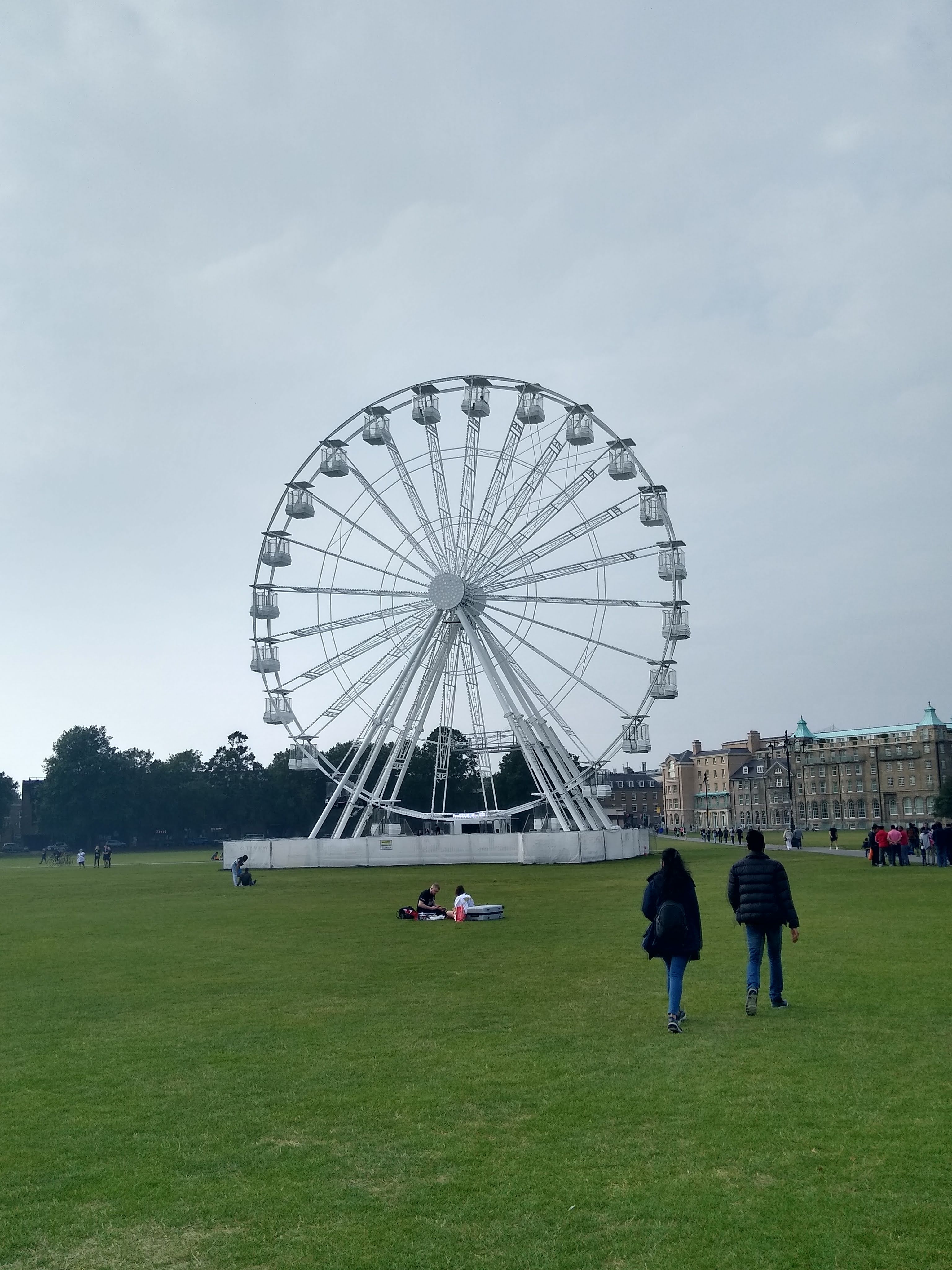
The amount of people of Christ's Pieces was off-putting, with the spectre of Covid almost unconsciously making us avoid anywhere crowded. We headed across to Parkers Piece, a wider expanse of green space. Parkers Piece currently has a ferris wheel located at its centre. A sort of lesser version of the London Eye. We were intrigued enough to give it a go. Not intrigued enough to ask what extras were included with the one first class 'carriage' which was distinguished by being painted black rather than white. The experience was slightly unnerving at first  It felt much higher at the top than it looked from below. At the top, the wheel stopped for a few minutes. Instead of taking in the panorama, I was distracted by the sight of some orange robed figures below, possibly Hari Krishna people which are quite a rare sight these days. I haven't been hawked one of their publications for some years.

Psychogeography, Cambridge, Parkers Piece

The wheel went around three times, which was unexpected, but on the other hand one rotation didn't allow enough time to take in the panorama. Being local, most of the views were of no surprise. But I spotted two large square white roofed buildings, still apparently under construction and surrounded by cranes. They appeared to be somewhere between Mill Road and Marshalls Airport. I still haven't managed to figure out exactly where or what they are.

Reality Checkpoint, Cambridge, Psychogeography

Back on the ground at nearby Reality Checkpoint we considered our next move. Reality Checkpoint is a four lamped post at the central point, where the two paths that cross the Piece meet. It is a well known local landmark and significant in the psychogeography of Cambridge. It is said to signify the point where Town meets Gown. For Cambridge University students it marks a transition from the University/College to Mill Road, a place much more accociated with 'Town' and a marked shift away from the 'Gown' University environment. Another persistent rumour is that the post has always provided a useful marker for drunk or stoned people who could recognise the lights as they crossed the Piece and so be roused from whatever otherworldly state they were in. In those circumstances, no doubt it serves as a useful reminder that the Police station is just across the road and to act straight.

'Reality Checkpoint' was scratched or painted on the post persistently for years. Yet more rumours have it that students and possibly staff from Cambridge College of Arts and Technology (CCAT), on nearby East Road ('town' side), were responsible for the upkeep of this. Each time the Council painted over it they reinstated 'Reality Checkpoint'. These rumours are probably enhanced by the attendance of  Syd Barrett at CCAT before he did Pink Floyd. The lights were apparently also a beacon during the 'pea 'souper' fogs of the 1950s. The name was finally made official and painted on permanently in 2017.

We found he post had been adorned with ribbons, which along with the staring red eyes of the fish, gave it a strange ritualistic air.

Reality Checkpoint, Cambridge, Psychogeography

We headed away from Reality Checkpoint and the Wheel, which now, again, seemed much less significant in height then when we were up there.

To contrast the view from the wheel, we headed onto the roof of the Queen Anne multi-storey car park across the road. The view itself was much less impressive than we had hoped. It seemed to be impossible to get to the highest point where a profusion of mobile phone masts and other antennae were sited, on what looked like a small tower. We made do with the other side, where the stairwell door deposited us. The deserted scene looked frozen in time from the 1970s, if you ignored the few cars that were parked this high up. We saw no people, though there was evidence of skidding and fast driving which seemed out of kilter with the limited space available. I imagined dangerous late night car meets, or maybe moped meets took place here, along with associated clandestine activities.

Car Park, Cambridge, Queen Anne, Psychogeography

Pedestrian access was limited, at least officially, to certain designated areas and the ramps between floors were off limits. The pedestrian depicted in the warning sign looked like a person from the era when the car park was built, judging by the slightly flared trousers and cuban heels. The person also looked to be adopting a strange hand gesture, as if the recipient of a 'back-hander'. This made me wonder about the origins of the car park. It was opened in 1971, after delays caused by lack of finance and because it went against the County Development Plan for the area. Obviously the lack of finance was somehow resolved and the planning issue somehow ceased to be a preventative factor. It still stands as one of few buildings in Cambridge that approach 60s/70s Newtown architecture, not quite brutalist but the nearest thing we have. The only other comparable buildings I can think of are other car parks, including Park Street ,which is of similar vintage and soon due for demolition to make way for a hotel.

Queen Anne Car Park, Cambridge, Psychogeography

We came back down a different stairwell and upon reaching the ground floor encountered a tea set, that had apparently been unpacked from a plastic bag and laid out on the floor. with some care. Rather it was a mixture of bits of different tea sets. The arrangement was odd but apparently deliberate. There was no sign of the people responsible and the purpose remained ambiguous. It looked like they may have been disturbed and left the scene in a hurry before anybody saw them, judging by the teapot on its side.


Gareth Rees described a plethora of unusual and normally unnoticed human activity in car parks in his book Car Park Life. But I don't recall him mentioning anything to to with clandestine tea and cake rituals in the stairwells.

Car Park, Cambridge, Psychogeography, No reentry

Although I was quite taken with some of the plates, it seemed wrong to interfere with the crockery and we we left it undisturbed. Once we were the other side of the stairwell door, there was no readmission. The door was locked behind us and the scene preserved, at least until the next curious passer by came along down the apparently little used stairwell.

Back over the road on Parker's Piece, we stopped at the trio of monolithic concrete structures in the South Easterly corner. These memorialise the invention of the rules of Association Football, which were conceived by the University Football Club in 1848. These days the University is more associated with Rugby. Meanwhile, Cambridge's second football team Cambridge City are no longer even located within the City. They share a ground with Histon FC, just outside the city boundary on the other side of the A14. Their previous grounds near Mitchums Corner was sold off for development a few years ago. Cambridge United, meanwhile, continue to remain at the Abbey Stadium but there has been talk in the past of selling the grounds and moving further out of town. Cambridge United are currently in 'Sky Bet League One', which as far as I can work out translates into what used to be called the Third Division. Meanwhile, City play in something called Level Four of the Non-League Pyramid. So, while the rules of modern football may have been invented on Parker's piece, the City's association with football prowess in living memory is not notable. I doubt Cambridge even made the long list for Ian Nairn's 'football towns' series. However, the location of both grounds is significant for being on the 'town' side of 'Reality Checkpoint', while two of the three Rugby Grounds in Cambridge are located well within the vicinity of the University dominated area around Grange Road and Newnham.

R said he'd heard that originally the football rules memorial was originally going to be a giant Subutteo referee figure, sited where Reality Checkpoint is. The idea was been scrapped in favour of the more subtle trio of monoliths, which align with Reality Checkpoint if you stand behind them in the right place.


Football, Cambridge, Psychogeography, Parkers Piece

Football, Cambridge, Psychogeography

We drifted into The Kite and stopped at the Elm Tree for a pint. The Elm Tree is one of a trio if pubs situated close together and the one with the most interesting beer. It was quiet when we arrived and we took a bench outside. Gradually more customers appeared and the other benches became occupied. We hadn't been there long when a character known as 'Dead John' made an appearance. I think it was a former barman at the Elm Tree who I first heard refer to the aging black clad figure using that name. Dead John always appears in modern day 'goth' garb; large thick soled black boots, a bag with rubber spikes on and sometime a top hat and cane. I have never heard him speak or seen him smile. The Elm Tree seems to be a place he gravitates to. It is said he is an academic of some sort. Unlike Disco Kenny or Bike Man, he is a character from the Gown side of Reality Checkpoint. The Elm Tree exists in a sort of transitional interzone where both sides meet. Disco Kenny is certainly no stranger to the Elm Tree and the other pubs nearby.

The Elm Tree, Cambridge, Pub, Psychogeography
 
After a nourishing pint of Brazilian Coffee Stout, we headed towards Mill Road, with the intention of taking the side entrance into Anglia Ruskin University (formerly CCAT). Near to this, at the end of Willis Road, is The Sinclair Building. This had been the HQ of Sinclair Research between 1982 and 1985, during the heyday of early home computers and the height of the popularity of the ZX Spectrum. Coincidentally, Clive Sinclair had died the week leading up to the walk and I had seen the building, with its original logo eblazened on its silver facade, featured on a regional news report that used archive footage. The report also had a man at the Cambridge Computer Museum demonstrating an old ZX Spectrum in action. He had the game Jetpac loaded onto the screen, one of hundreds of primitive computer games that are seared into the memory of a certain demographic. 
 
Now Spectrum emulators are available online so that these pre-digital, originally tape loaded games can be re-lived. Like old music, films and other cultural artefacts that would otherwise have aged into obscurity, obsolescence and inaccessibility, the digital age has brought these games back from the dead, into a period where they are no longer the captive of a particular time or space nor belong to a particular generation. Sinclair was part of 'the Cambridge Phenomenon', a phrase coined in 1980 to describe the explosion of Tech companies in Cambridge that began in the 1950s. I recently found a publication in a charity shop of the same name, a report by some consultants produced in 1984. It is contemporary with Sinclair. The 'phenomen' has continued to explode and now Cambridge is home to offices of Microsoft, Amazon and Apple among many others in the tech field. ARM now occupy the site of the old Acorn building on the edge of Cambridge. Acorn was a comtemporary rival of Sinclair with its Acorn Electron and BBC B computers. The old games played on Spectrum and Acorn computers are still alive and well, embedded in the digital world far more advanced but that descends directly from the earlier technology those companies helped create.
 
The building behind the gates we stood next to still had the silver facade at one end, but the old Sinclair logo had gone. The building is now part of Anglia Ruskin University. An older looking sign still remains on a low wall outside.

Cambridge, Sinclair, Psychgeography
 
We found the back gates of Anglia Ruskin locked. It turns out they are only open during the week, when the public are free to pass through. It serves as a useful and interesting shortcut to East Road, which is where we intended to head next. We had to take the alternative route through the graveyard that runs behind the campus instead. 

The graveyard in recent years has become more popular for use not just as a cut through but almost as a park. During lockdown it became a place festooned by dog walkers, who could be seen chatting in the middle of a small green space on the site of the old chapel. Meanwhile, their dogs would run amok into the surrounding graves and bushes to chase balls thrown by their owners and occasionally would make unwelcome advances to other people who sat on benches hoping for some peace and tranquility before work. Previously, the graveyard had been noted for anti-social behaviour like drug taking, drinking and grave vandalism. Indeed, during lockdown for a short period, an apparently threatening character had been marking graves with satanic symbols and was aggressive towards anyone who challenged him. I never encountered this troubled character, and I suppose by comparison the odd irritating dog approach or stray turd is much easier to deal with.

Mill Road, Cemeterary, Cambridge, Psychogeography
 
We emerged onto Norfolk Street, opposite the small parade of shops. R and myself used to come here on Saturday mornings many years ago to eat breakfast at the Athena Restaurant. This was a particularly excellent Grease Cafe of the sort no longer seen in Cambridge. There are still places to get a fry up, but none are really proper greasy spoons. The premises are currently occupied by Eko Kitchen, an African Restaurant, which I still need to try. Previously, after the Athena, it was the Pandahar Indian Restaurant. So it was good to see that, though the Athena has been lost to the whims of history, the tradition of interesting and not overpriced food continues on its location.

The demise of the Grease Cafe in general has parallels with the decline of the proliferation of traditional wet led pubs. Both seem superficially to be the victims of a culture promoting healthier lifestyles. But since places like McDonalds and Kentucky Fried chicken, and sales of wine, beer, energy drinks and other junk food items at shops don't seem to have declined much, this can't be the sole cause. Property development and Whetherpoons are probably equally, if more, to blame.

Nigel, Tag, Cambridge, Psychogepgraphy
 
I'd never really noticed the metal shutter across the street before. I couldn't recall what, if anything other than the metal, had been there before. The ubiquitous Nigel had got there before me, or possibly one of many Nigels. The tag is everywhere. I suspect behind it there is a grafitti/street art version of Luther Blisset, with a multiplicity of people using the tag and acting as a loose collective.
 
We left Norfolk Street, and crossed into Burleigh Street, past the old Boat Race pub, now a vegan eatery of some sort. Burleigh Street was busy with post Covid shoppers, emerging mainly from Primark. We avoided this by taking the route behind the shops, before re-emerging further up the street near the entrance of the Grafton Centre. 

It was announced recently that the Grafton Centre had been sold. Its future looked uncertain. Before Covid it was struggling to fill shops, and saw the departure of British Home Stores. Covid made things worse and the loss of Debenhams was perhaps the final straw. While neither of us had ever had much of a fondness for the Grafton Centre, we thought a (possibly) final visit was in order. This was also influenced by the comparative lack of people inside as compared to outside on the street and the knowledge that it contained a toilet. The stout quaffed earlier was re-making its presence felt. 

The atmosphere inside was lacklustre. The people wandering around inside looked even more bored and aimless than usual. The Grafton had been used as a Covid vaccination centre but that activity seemed to have ceased. Of the few shops opened, none enticed us inside other than a sort of Mediterranean deli/shop. Though some of its wares were tempting, there was nothing that could be consumed immediately and I couldn't really muster up much enthusiasm. I think in part, this was due to the 'indoor shop-ness' of it. In my mind there is still something not quite right in emerging out of a shop and still finding yourself indoors.
 
Some of the other 'units' that were not empty were being put to alternative uses. In the indoor ping-pong hall that had been here a while, the cow statues from the Cambridge Cow Trail had been herded inside. This was to allow viewing for their auctioning off. The Cow Trail had been a phenomena over the summer, consisting of a large number of identical cow sculptures that had each been customised by artists and schools. I had considered doing the trail in its entirety, but never quite felt like it, instead I had 'visited' the sites of some of the cows during random walks. The cows had been mostly confined to central Cambridge and the area around the Station, but a couple had been posted at Cambridge North Station. 

We decided not to go in, due to the relatively high number of people. Instead we headed up to the balcony, where the entrance to the cinema and various eateries link to the stairs and the car park and some toilets. We checked out a couple of the food vans, the sort that normally park up as  'streetfood' offerings at events. Somehow these had been elevated up to the second floor. We were not enthused by their offerings or of those in the cafe below.

The view across towards the former British Home Stores (now H&M and a Gym), invoked feelings of emptiness and fatigue. Even though the Grafton was not my favourite place and I've never quite forgiven it for replacing the part of The Kite that I never really got to see, I did feel a bit sorry for it. I even had a flash of nostalgia for the days of fish smelling supermarket Prestos, the Reject Shop, Our Price and even the officious security men and their random tannoy announcements.

The scene we looked over now had once been a continuation of Fitzroy Street before it was bulldozed to make way for the Grafton Centre. It represented a lost future where there might have been a proper outdoor street lined with shops, grease cafes and pubs surrounded by reasonably priced terraced housing for rent or purchase. But more likely it would have ended up heading towards gentrification in the same way as Mill Road. Instead, the Grafton Centre and the pedestrianised Burleigh and Fitzroy Streets immediately outside, are places 'ordinary' people go to shop. Places firmly on the Town side of Reality Checkpoint, physically and metaphorically, as they would have been before the Grafton was built, back to when the Kite was part of Barnwell. So paradoxically, the bland Grafton Centre has in some ways been a force against gentrification, if nothing else. But with its sale and the mystery of what it might become, maybe that will all change.

The Grafton Centre, Cambridge, Psychogeography, The Kite

The lacklustre atmosphere of the Grafton had permeated us. We walked a bit further to Jesus Green. Somewhere here border of F5 crossed the Green but we had lost our concentration and overshot. Somewhere around Jesus Green Lido, well outside outside square F5, we called it a day.