Showing posts with label Concrete. Show all posts

Thursday, 19 July 2018

Observatory bunkers.

I wandered away from the river past the Key Theatre, where a group of office workers were hanging around outside, evidently undertaking some sort of team building activity or training. Flipchart paper was stuck on the windows where they congregated. Otherwise the building looked deserted. The cafe/restaurant/bar which was partly what attracted me over in the first place, was closed. Maybe the office workers were planning a strategy. If they were, it looked like they were unsure of what it might be and were in no rush to reach a decision.

Just past the gathering I noticed a white box like brick construction half emersed in the ground like a bunker. There was a sort of grill through which some sort of electronic device was kept. Maybe meters for utilities, but it seemed an odd place to keep them. It looked like an oversized microwave oven made of brick, or the back of a refrigerator that was buried three quarters into the ground. It was facing directly at the theatre and the office workers, as if observing them.


Just before I encountered the office workers, I had seen another 'box'. This one had been smashed up, the lid and grill had gone and the electronic device was exposed. I hadn't taken much notice until I came across the second one, still in tact. What these bizarre structures were, or what the devices inside them did, I had no idea. Who had smashed up the first? The office workers? Had they been overcome by some terrible malaise causing them to destroy technology that frightened them, similar to the situation described in the peculiarly sinister children's TV series 'The Changes'? Perhaps they knew something the rest of us didn't and were planning on fleeing the city to find a safe haven in the country, or at the coast, or in France. Somewhere away from the constant stare of the observatory bunkers.


Wednesday, 6 June 2018

New River Sojourn: Broxbourne Station to Hoddesdon and return.

Work took me to Hoddesdon, which meant a train to Broxbourne and a shortish walk (around a mile and a half). My instructions had suggested a taxi. A preposterous suggestion I thought.

Broxbourne station has it's most useful facilities convienently located in the bridge over the platforms. A waiting area, loos and a couple of snack outlets.  I passed through the ticket office downstairs, that seemed more London Transport than British Rail and  looking back at the station from the outside, it looked as much like a tube station as a mainline station to me. It was sort of 60s 'brown box' with white plastic lettering. At first glance it seemed out of place in the  surroundings, which were mainly trees. But this was Hertfordshire, the Southern end, which is a place with countryside trappings but at the same time one that has not quite escaped London.


On the map, Broxbourne and Hoddesdon are part of a sort of corridor that extends into London following the New River and River Lea along the Lea Valley. The map shows no gap of Countryside between these places and Enfield, Ponders end and ultimately Stoke Newington at the New River Head. It's as if Broxbourne, Cheshunt, Hoddesdon etc al are trying to escape the metropolis, while it reaches up , dragging them back into it's amorphous edges.

This 'corridor' also contains the Lea Valley Regional Park. This was subject to a project we had to do at University, a sort of role play to decide how the park could be developed to attract visitors and improve it. My group were the 'developers' so our task was relatively easy, if unpallatable. We argued for a casino and lesuire complex to be built on the grounds of revenue generation and job creation. Luckily in real life this never happened. Around the same time I bought the LP 'New River Head' by The Bevis Frond which had just been released. Both New River, it's Head, and the Lea Valley park are places that only existed in my head for years, but had a sort of mythic significance due to these separate but contemporary events. Later, the beginning of Iain Sinclair's London Orbital was set in Waltham Cross, part of the same corridor. Another place that I've never been to which only added to the myth.


So the decision to follow the New River towards Hoddesdon was the only route to take, also influenced by the fact that the road route looked like it might be a bit main road-y and dangerous  The river footpath was raised up above the station. A short distance along, it felt less London. No buildings, plenty of greenery etc. But still commuters and a ropey looking car park/waste land on the left reminded me I wasn't quite in the wilds. The path on this stretch had recently been widened and surfaced. A bit further up a lone workman was finishing the task. I was pulled out of my walking hypnosis by the sound of his radio broadcasting some loud tinny pop music.

On the other side of the river was an old pumping station building, still apparently in use for something.


I eventually left the path after a narrower stretch yet to be resurfaced, crossing at a  green iron footbridge. This took me down a small path which soon came out into a typical looking sleepy suburban street. Apart from a skip lorry having some difficulty parking up and which eventually gave up and went away, I saw no one. I soon came across a turning into another footpath, the walls and fences strangely graffitti free. This lead past a school and eventually emerged into the grounds of what may have been an old people's home. The other side was the main road leading into Hoddesdon town centre. I followed the path through an arched construction with roses growing around it. This was typical of the sort of manicured and nanna-ish prim landscaping along this stretch, similar to many small market towns. Walking through the arch I wondered if I would go through some sort of metamorphosis and age a few years. I think I survived in tact.

Across the street was a museum and a slightly unusual red post box, with a strangely ornate top. Pre-Royal Mail privatisation vintage for sure. Do they even make new post boxes anymore?


Next to the Museum the Spotlight venue was advertising fotrthcoming attractions, from Pepper Pig to Simon and Garfunkel. A similar roster of 'stars' to those you get at Cromer Pier. Later I saw a poster for a Robbie Williams tribute act. Has-beens and tribute acts I always think are the live entertainment equivalent of a wedding disco. Hard to get enthusiastic about but to criticise feels frivolous and a bit cruel.

The symbol of Broxbourne Borough Council was displayed on the notice board: a badger. A symbol of ruralness I suppose. You don't hear much about urban badgers, unlike foxes.  On the other hand, 'borough of Broxbourne' sounded suspiciously Greater London to me.


I continued into Hoddesdon. The high street initially had a bit of what Americans call a 'quaint' feel, with Georgian buildings and oldeworlde looking pubs (from a distance). Happily, this was soon quashed with the first sight of a charity shop and a market  selling real things that might come in useful rather than expensive artisan products. There was a fruit and veg stall where the man was shouting 'two punnets for a paaaahhnd'. Another man was selling 'Marks and Spencers ' duvets and pillows at very reasonable prices. Another stall sold hardware. Further up it began to resemble a car boot sale. The atmosphere was similar to a London market but smaller and with a significantly older and whiter population. It was like being in a sort of ex-pat zone for ageing cockneys. There was even a pie n mash shop just off the main drag. Later I lunched their. The other customers mostly being some aging bikers belonging to something called the 'Lakeside Chapter'. A delegation from an Essex shopping mall. Not quite the Sons of Anarchy, more the Grandads of Retail Captialism.


Ahead I could see a large tower building at the end of the street. This seemed somewhat out of character and this made it's appearance even more stark. Although in keeping with the ex-pat theme I supose since it resembled the sort of buildings that proliferate along the Costa Del Sol. As I arrived at the 'tower', alligned with it in the immediate foreground was a cross and behind that a clock tower. Both dwarfed by the building which seemed both modern and decrepit in comparison to its surroundings.


Closer up it became clear the building was a Morrisons on the ground floor and a block of flats above. A smaller block in the foreground, titled 'The Pavilion', contained 60s style shopping arcade with offices above. The arcade contained little of interest and tiresomely a Costa Coffee. Luckily a very good, and much busier, grease caff was over the road where I took breakfast along with a number of the hi-vis jacket fraternity. Always a good sign in such places.


The large Tower Building was called Tower Heights. The residents access was around the side, where they are greeted everyday by concrete abstract art built into the wall next to the doorway.


After my appointment, I decided to walk back to the station a different way. I turned right at the clock tower,  passed a building that appeared disused, featuring some cryptic 'streetart' and a door painted in similar colours to that of the uniforms worn by employees of Greater Anglia Railways. It looked like it hadn't been opened in some years.


Round the corner , at a junction a sign pointed to something called 'Lambpits'. I followed it and it lead me through an underpass under the junction beyond a Sainsbury's on the corner. The area had a semi-industrial estate feel.


Having emerged back into the bright sunlight, I soon discovered Lambpits. A housing estate with some slightly odd buildings. The one below looked half garage half bungalow. The pylon magnificently rising up behind it adding to the mildly sinister 70s public informstion film atmosphere.


I negotiated my way through the estate, and soon found myself back on the New River Path. The first stretch was deserted and despite the unpleasantness of being exposed to the sun, I enjoyed the tranquility. I observed what looked like three purple velvet moths drifting about on the bank of the river. Closer inspection showed them to be some sort of damsel fly. They appeared to stay with me like minature guides until I reached a crossroads where the path became surfaced and widened. The same  place I encountered the workman and his radio earlier. He had long since knocked off, no sign of him of his cohorts.

I decided to turn left rather than carry on. This resulted in a brief foray into a wooded area which forked off in one direction to a small recreation ground where children were merrily charging about. I went the other was and emerged onto an overgrown desire path. This eventually lead to a dead end, the way ahead back to the river path blocked. I grudgingly retraced my steps. I was sligy concerned that the children or their parents might think I was some sort of suspicious character. Or worse, a lost insurance salesman.


Soon after this diversion I was back at Broxbourne Station. I'd just missed a train so with time to kill I resorted to google maps to check the whereabouts of the nearest pub. There was one not to far away near a marina. This involved crossing a narrow bridge with not much of a path over a busy road, before heading down a track towards the marina between a car park and a set of steps leading up to something the other side.

I took a diversion up the steps and found myself on a strange concrete expanse. One side of this there were railings looking over a large green area which resembled a bizarre sports green or amphitheatre. There was no one around. It felt slightly otherworldly, as if i'd crossed a line into somewhere closely parallel to the here and now. I considered walking across the green but my thirst got the better of me.  I imagine I had been above a reservoir or water works of some kind but the place was odd.


I forget the name of the pub. It was a large riverside affair, cavernous with several seating areas. Aimed largely at diners, and presumably the boating fraternity.  But at this time of day less than busy and the empty darkness of the interior, away from the sun, was welcoming. I rested for a while before heading back to Broxbourne Station and catching the train home.

Friday, 11 May 2018

Rural wandering in South Cambs X 2

Peterborough walks have been on a hiatus lately due to business at work  and working away. Then the bank holiday, when I spent a couple of afternoons walking with my partner around some of the villages just south of Cambridge.

My partner is much more rurally orientated than me, which means I occasionally venture out to a place I previously wouldn't have bothered with much before: the countryside . Left to my own devices I'd have been unlikely to go out into the sticks very much. In the past I considered the countryside a bit boring, conservative, remote, difficult to get to (and more importantly from) and lacking in amenities. More recently, I've learned to drive so going to these places is more possible and forces me to practice. Going anywhere by car is still my least preferred  mode of travel, but does have its uses on these occasions. Before my attitude had been if somewhere couldn't easily be reached by foot, bicycle or public transport (preferably train, not bus) then it probably wasn't worth going to. My view has shifted in recent years, and i'm nearly as happy going for a rural wander as an urban one. I don't know if this is because of gentle coersion by my partner, learning to drive, or just getting older and appreciating different things.

Walk 1: Eversden Woods and environs.

The first walk involved parking up in the village of Great Eversden. My memories of the village itself are already a bit vague. Nothing remarkable, bigish houses and big gardens indicating fairly well off residents, no pub (apart from one now operating as an Indian Restaurant), no shops or cafes. There was a church (more of this later). We parked near it and headed off down a footpath. The objective of the walk was to go to Eversden Wood where we could catch the last bloom of bluebells. We thought it would be less busy than the other bluebell woods in the area which were more well known being managed and advertised by people like the Wildlife Trust. The irony of going out to the countryside to get some peace and tranquility away from town, only to be thrust among a mob of families and their dogs was something we wanted to avoid.

Before reaching the woods we stopped for a rest on a ridge, overlooking a farm, the village and towards Cambridge. The behemoth of Addenbrokes Hospital could easily be seen in the distance, as could Eddington and the wind farm near Fleam Dyke near the village of Fulbourn. There was nobody about on the ridge. It was peacful yet strangely surreal. It's not often you get up high in Cambridge (I'm talking very relative, it wasn't Ben Nevis). It was a bright and sunny day and lhe light was reminiscent of that on 70s TV programmes I remembered seeing about the Countryside as a child. At that time it seemed another world, one I wasn't particularly interested in. One where a patronising man told you to follow the country code and notices told you to keep out of fields. The light had a strange quality in these programmes which seemed to be slightly off kilter with real life. Maybe it's the type of film they used. But it seemed to mainfest itself on the ridge.

We got to the wood. Suddenly in the shade, out of the sun which was getting a bit much for me being a pasty faced individual with little tolerance for it. The bluebells were competing with a profusion of other plants and brambles. We saw nobody else as we progressed into the wood along a path that became increasingly quagmire like the further we went. A prolonged wet spell had left it's mark.

My choice of footwear was a bit ill advised for this sort of thing. Roamers 'Jason' suede slip on desert boots are ideal for walking in an urban environment (or anywhere dry and not too lumpy really). But they are neither water or slip proof. Just as things were starting to get awkward I found a large stick which I could use as a steadier and to gage the depth of puddles. I felt like a character in one of those terrible dungeons and dragons games, who finds a significant object that will assist in the quest. In this case to get to the other side of the wood without slipping into water, nettles or brambles. The staff of stability! I briefly fancied myself as a sort of Merlin, as he was portrayed in the film Excalibur. But a subsequent near slip brought me back down to earth. A panama hat wearing middle aged buffoon would be closer to reality.


The path widened into one where vehicles had obviously been used, adding to the quagmire. At this point the walk became a bit like a rural version of the Crystal Maze, circumnavigating edges of puddles trying not to fall into nettles and brambles while avoiding the mud and pools of water. A mysterious dustbin like object ahead appeared like a poor quality dalek. It turned out to be a device to feed pheasants. I'm not sure I really agree with breeding pheasants to shoot and eat. Apart from being cruel, it seems a lot of effort to go to given the tiny amount of meat they have on them. Like other 'country pursuits', foxhunting, hare coursing, horseracing etc I don't really understand the appeal or approve. But then, I'm not from round these parts. I'm sure the Barber Jacket and welly wearing contingent would remind me of that and tell me I wouldn't understand their country ways. And I'd agree with them.


Out of the woods and into the brightness of a field. We followed the quagmire path above, rather than the dryer path that appeared to have been the result of spraying some sort of dangerous weedkiller. A reminder that farms and much of the rural environment they govern are industrial in nature..literally.  I recalled, vaguely, the Sunday lunchtime TV programme 'Farming Diary'. I can remember a panel of two or three men presenting it, looking like Bob Fleming from the fast show. The commercial break was reserved for adverts relating to farming. Enormous radioactive looking orange sacks of fertiliser, combine harvesters and sprays to kill weeds and insects. I also remembered the smell eminating from the Fisons factory in nearby Hauxton when my friends Dad, who worked there, took us fishing at the mill pond in the grounds and to the social club, where the crisps tasted of the same smell.


Some time after crossing the partially poisoned field, and resting in an apparently unpoisoned one inhabited by a number of crows (or maybe rooks) and pigeons, we came across the concrete circles of a reservoir. At the same time, in the distance, I could see the white disk of a radio telescope. We had moved from depressing Sunday afternoon  advertisments for poisonous agricultural chemicals to an environment reminiscent of the Quatermass mini TV series from the 70s. Both dystopian, but the later at least offering some hope.


Within the compound of the reservoir was a trig point, reminding us we were still at relatively lofty heights (for Cambridge).

An orangy stone had been left on the fence. I wondered if I should have collected this to complement my staff, but decided against it. It resembled a russett apple. I thought it looked good where it was. With the trig point, this added to the sort of stone circle like atmosphere of the compound.


A notice nearby warned of the laying of a 'relevant pipe'. This didn't look like it was going to be much of an impediment. Work had started, but had only progressed a few feet. I'm not sure exactly what a relevant pipe is. Can you have an irrelevant pipe?

It's relevance to us was that it was pointing in the same direction we wanted to go, back into the village (I suppose a pipe taking water away from a village might be the irrelevant sort).

The path lead eventually back to the church. We had a look round the churchyard before we left. The whitewashed building was unusual and impressive. Somewhat marred by the sign next to some gravestones showing sponsorship by lottery funding. They say lottery ticket money is dead money...


Walk 2: The Shepreth Barrington Meldreth triangle.

This walk may have been rougly triangular, or possibly more of a rhombus,  but didn't really feel like it. The main road from Shepreth to Barrington was closed. We enquired at the café (the tea and cake sort, not a grease caff) and the man helpfully found out for us that pedestrian access remained, only traffic couldn't get through.

But we didn't go that way, we followed a footpath/lane that eventually lead to a large field of oil seed rape. A path carried on, a stream or ditch on the other side. The oil seed rape, a type of brassica, resembled a yellow inedible version of purple sprouting brocolli close up. From a distance a sea of monotonous yellow. We followed the field round and crossed a stream/river over a wooden bridge then down a grass path walked off by two high hedges, as green as the grass. Like a maze except straight. Further along was an open iron gate, leading to what appeared to be a graveyard. There were only four or five graves and we concluded it was probably someone's garden. A bit weird but we thought best not to investigate further.

Soon we were on the main road through Barrington, bifurcating Barrington Green. This consists of a very large grass verge each side of the road and a large village green with a cricket pavilion. We stopped on the village green for a rest. No one was playing cricket (no one was there apart from the odd passing car). I recalled the scene in the film 'The Shout' where Alan Bates' character is revealed to be a mental patient, helping keep the score in a cricket match between villagers and inmates, before he loses it and get carted off. The film was set in Devon and this was Cambridgeshire. But village greens all look pretty similar. Another, maybe tenuous, rural/folk horror connection was the pub The Royal Oak which can be seen up the road from the Green. A woman who dressed as a witch used to be the landlady. I was aware of this at the time but didn't know where Barrington was then and never saw her. Walking past, I noted it has not retained any trace of Addams Family/Witchy connections.

Just past the pub, over the road is stream including a sort of pond resulting from damming (not the large concrete sort obviously). We sat and observed the pondlife. Waterboatmen, snails, pomdskippers and fish (of the tiddler variety). Within the pond was another world containing these creatures, swaying aquatic plants and air bubbles gently drifting to the surface, which was easy to become emersed in. And we did for some time. I remembered David Bellamy's backyard safari, where the presenter was 'shrunk' in order to observe ants and snails from a different perspective. I don't remebere if he ever dived into a pond.


We headed down the road back toward Shepreth. This was the road closed to traffic, which as walkers was in our favour. At a small (and empty) car park we found the entrance to a meadowy environment around which the river could be followed. We took the path that sort of followed the river and at some point we stopped to looked at a willow tree with a large hollow.

In the hollow I noticed what I thought was a  discarded  packed lunch box. Closer inspection revealed this to be a Geocache box. It contained a lighter, a toy police badge and a cotton real. I've never done Geocaching and am unaware of its finer points. I didn't have anything to leave in the box and didn't take anything. I put a note in the log book including my blog web address. Maybe I'll be regarded as a 'muggle' in the Geocaching community for doing this. But I wondered if there was some crossover with Geocaching and psychogeography, and I'd not maybe there should be. Geocaching encourages walking and a certain amount of exploration, as does (did?) the more virtual Pokémon. But maybe there's too much purpose involved, too much of a point to it. There's enough of that sort of thing in day to day life. I considered my intervention by leaving my note in the book as a psychogeographical ''wave' to the Geocaching community, a friendly amd mischievious disruption of their possibly more serious pursuits. And a shameless plug for my blog.


Across the other side of the meadow, we entered another sanctioned path in a woody area. The boozy detritus left behind in this pool indicating a more upmarket outdoor drinking fraternity. No strong lager or Thunderbird here.


I can't recall much else of the wooded area. We emerged onto a road, which would take us to the edge of the village of Meldreth.
The road was one of those with no path, and no obvious speed limit making it potentially hazardous but traffic was luckily light.


We passed through the outer edge of Meldreth. The village sign was a sort of wrought iron affair, not the usual type. Slighty sinister. When I was younger I heard tales of a gang that often got on the train at Meldreth and were to be avoided if possible. The Meldreth Mafia may well have been the figment of someone's teenage
imagination. But if they did exist I imagine they could have been responsible for burning down an earlier village sign. This one looks more fireproof.

                     
Just outside of the village, we entered L-Moor, a scrubby sort of meadow now under the control of the Wildlife Trust. The explanatory sign at the entrance gave an explanation of the history, but I was distracted by the image of the Manx Longhorn Sheep, with its Baphomet like horns. The area a bit of a strange and archaic atmosphere, which I imagined being more intense on a misty winter day, when the sheep were grazing. They had been banished for the summer so disapointingly there were none to be seen.


The ground was lumpy with ant hills, having not been cultivated since the 1800s. It was divided by the railway line which was passed under via an old foot tunnel.


There were different coloured bits of plastic tied to a fence just the other side of the tunnel. I'm not sure what the significance of this was. Maybe they had been put there officially for some mundane reason. Or maybe they were the remnants of some sort of ritual, involving the Manx Sheep and dancing through the tunnel naked on the Sabbat.


Short after this we stopped for a rest. The electrified railway on one side, and an electricity pole on the other. In my line of sight to the pole was a flower, rare and known as a milkmaid according to my partner. On the railway line, two engineers wandered past talking in Brum accents, clad in radioactive Fisons orange. Like a couple of alien observers, keeping to the track just to be sure.


After leaving L-Moor we followed a path back to Shepreth. Just before coming out near the church, we passed a sort of agricultural machinery graveyard. A ramshackle array of tractors, lorrys and bits of plough, in various stages of ageing, rust and decay. Giving off a Texas chainsaw massacre/Dukes of Hazard sort of a feel. The gate was locked or I'd have been tempted to wander around it.


We arrived at the church. Less remarkable than the whitewashed one in Great Eversden, other than the roof. No spire, presumably there had been once, but a newer roof giving a more ominous feel, reminding me of 'The Black Tower'.


A lumpy and lichen infested gravestone was the other odd feature of the churchyard. Looking like it had become diseased or had been squeezed by a giant hand.


We emerged back into Shepreth, a village fairly indestinguishable from Great Eversden at first sight. It does have a pub, The Plough. We stopped for some water.  The pub looked like it had received the 'Farrow and Ball' treatment and we were expecting it to be poncey but quiet. But the garden was given over to a children's playground and Queen was being played at high volume indoors, where a handful of regulars dwelt. We decided to head home.


Saturday, 7 April 2018

The Underpass from Stanground

Friday. Last day before a week off. I decided a longer lunchtime walk was in order. I headed to Stanground. I'd seen it from the train with its bungalows resting on the waters edge. And a church spire which I decided I would try and reach.
At the end of Fletton Avenue I followed the road under a flyover. One of a confluence of several roads passing through the behemoth of concrete led me into Stanground Village. I turned left onto what I think was the Highstreet, opposite a light-industrial yard containing a tattoo parlour. The area featured a couple of MOT garages and used car places. I spotted a pub, The Golden Lion. Boarded up, permanently closed, a drink out of the question. Opposite a chip shop which was almost tempting.

Although I was only just outside of Peterborough the village could have been miles away, in the middle of nowhere. It retained some of the atmosphere of other places in the city but felt cut off, temporally and spactially. For a few minutes I forgot where I was. I could have been in one of the more crumbly and run down villages of Cornwall as easily as the bit of England which is half East Midlands, half East Anglia.

After I passed the Baptist Church, house in a brown 1930s type building that could have passed as an old workshop, the houses began to look more salubrious. Smarter terraces and old cottages.

Soon I was at the church who's spire I had seen from the train. I followed the path past it. I took an old man walking ahead of me as a barometer of safety. I wasn't sure where it would lead.

I crossed a brook, running along some bungalows similar to the ones seen from the train. A path ran alongside, I noted for a possible future wander. The houses looked pleasant. Although one was sporting a St George's flag on a large pole in the garden. Possibly too soon for the world cup..

The path continued through an underpass, splendidly tiled. As I passed through, a cyclist was appeared from the blinding light at the other end. Instead of emerging into some sort of heavenly nirvana, when I came out the other side I recognised the path back across the dual carriageway that I had walked over on a previous excursion. My route back to work.

Monday, 5 March 2018

Beyond the Bridge

5 March, 2018


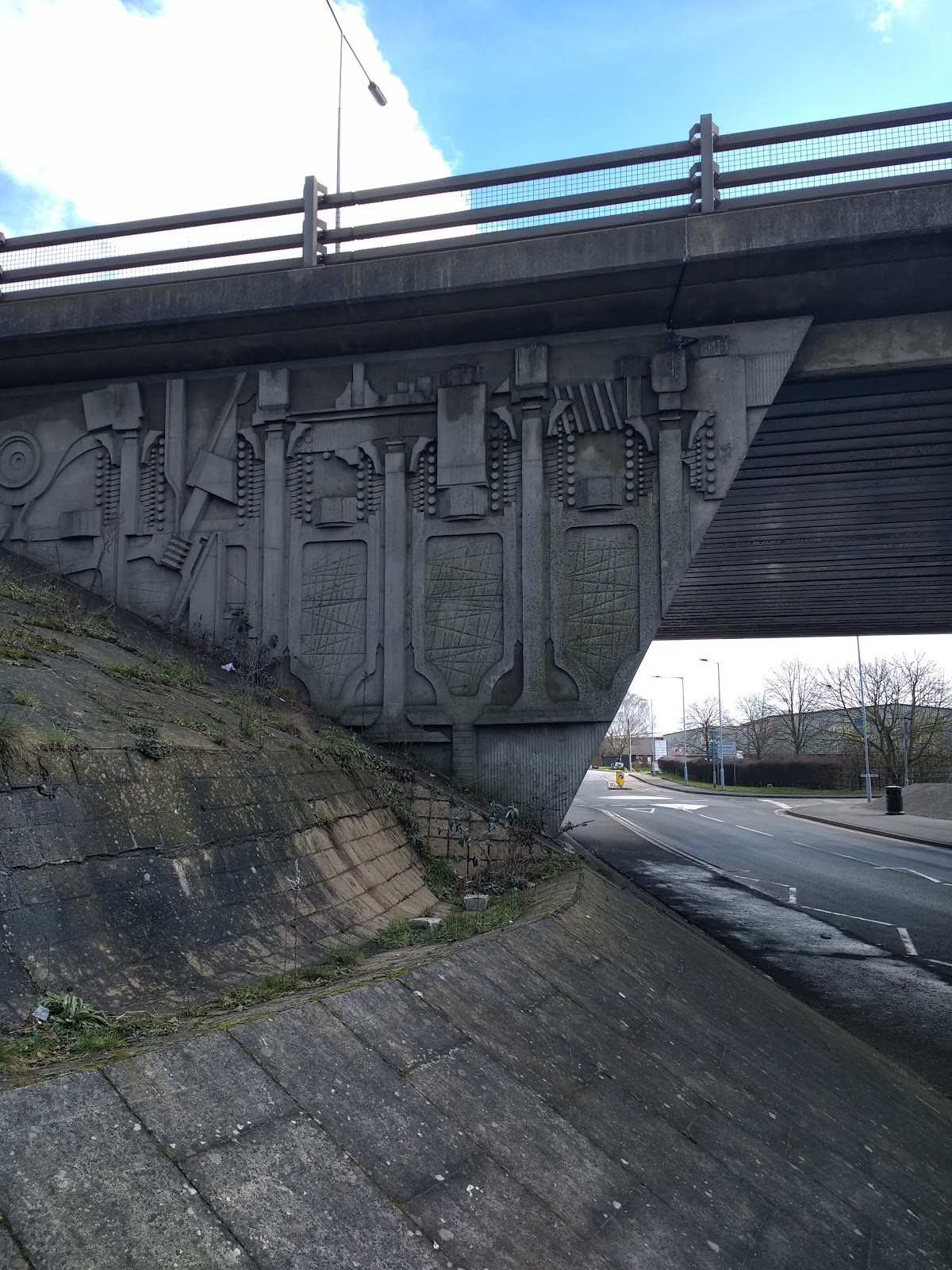
Heading East, I reached the concrete bridge going under Frank Perkins Parkway, one of a series of dual carriageways encircling the City. The road is named after a local early 20th Century industrialist who was big in diesel engines. The engravings on the bridge presumably some sort of reference to Perkins, are strangely reminiscent of Eastern Bloc brutalism. I was short on time, but the urge to pass 'through' made me abandon worry of such trivialities.


Beyond the bridge the environment changed immediately. Used car lots, MOT test centres, an industrial estate or two. Further up a dog track. A grease cafe, currently closed due to family illness. Hopefully a temporary phenomenon. A blacksmiths operating out of a bungalow. A mobile home park.  I felt I'd been teleported to a place far further out of town than I actually was by passing under the concrete bridge, both physically and metaphorically.

Eventually I managed to loop back via Boongate, negotiating a busy slip road where a footpath had abruptly and inconveniently ended, then through a residential area which turned out to lead me to Star Road. I knew where I was then and made it back, only 10 minutes late.